Is Sondheim Classical?

The Australian Broadcasting Company recently released a list of the “Top 100 Classical Pieces of the 20th Century.”  As with any list, there is much fodder for discussion, debate and derision (judging from this list, Stravinsky apparently stopped composing after 1913). Blogger, pianist, and educator Elissa Milne was particularly disturbed by the complete omission of Sondheim’s work, particularly considering the inclusion of Bernstein’s West Side Story in the top 20.

Now I love Sondheim’s work with a fiery passion. My first exposure to Sweeney Todd in middle school forever altered my understanding of musical theater and its possibilities. The most viewed posts on this blog are in depth analysis of his works. Stephen Sondheim is no slouch. However, I find that his exclusion from this list of classical works, even in light of West Side Story‘s inclusion, makes perfect sense. There is something inherently more classical about West Side Story than any of Sondheim’s work.

In my admittedly unconvincing responses to Elissa’s tweets, character challenged as they were, I pointed out that West Side Story is more suited for the concert hall with symphonic suites and adaptations, and that there are nothing like the ballets of West Side Story in Sondheim’s work (with the exception of the “Cookie Chase” in Anyone Can Whistle, which seems, like of much that piece, rather self conscious). But these are more symptoms than causes. The real reasons that Sondheim’s works are inherently unclassical is also their primary strengths. I would characterize these strengths as a combination of specificity and inviolability.

The beauty of Sondheim’s music and lyrics are that they are Read the rest of this entry →

leave a comment Share on Facebook

11

Dec 2011
17:12

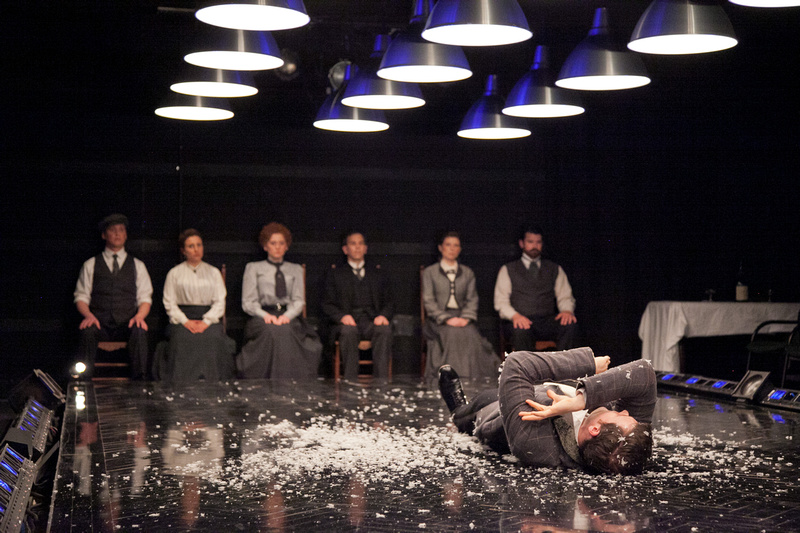
Glacial is the New Black: Satyagraha and Shen Wei

Stare at image for 2 hours. Intermission. Resume staring.

Somewhere imprinted in my brain is a sacred rule of story: take only as much time as you need to get an idea across. Get in, make your point, get out. Keep things moving and don’t lose your audience. But this week in New York two separate pieces, both non-narrative, reduced me to tears by combining a staggeringly slow pace with one or two immense gestures of inspired stagecraft that hit at just the right moment.

SPOILER ALERT – the unexpected nature of these gestures contributed much to their impact. If you plan on seeing either of the pieces discussed, reading this essay could well rob you of that discovery. Shen Wei often tours the country and you almost certainly have a great opportunity to see Satyagraha on screen in your local movie theater this Wednesday, Dec 7 via the Met’s Live in HD program. Perhaps go see the work and then come back and read this.

The Shen Wei Dance Company performed an evening of works adapted or created  for the mammoth Park Avenue Armory space. Read the rest of this entry →

leave a comment Share on Facebook

05

Dec 2011
10:12

Thoughts on Robert Ashley’s “That Morning Thing”

This is not the morning thing you're looking for...

Composer Robert Ashley’s “opera” (experimental performance piece is a more appropriate name, although if an opera is a multifaceted convolution of music, text, and motion, I suppose this is an opera) That Morning Thing, produced for the first time in 40 years at The Kitchen as part of the Performa 11 biennial, is among the most difficult pieces I’ve experienced. It’s dark. Dark in a way that I wasn’t expecting, dark in a visceral, what the heck just happened to me, I didn’t sign up for this kinda dark. This isn’t (necessarily) a bad thing. But it is a thing that is likely to stick with me for a while. What follows is less a review as it is an effort to come to terms with what I saw and how I responded to it.

Please note, a work like this is bound to be understood in a very subjective manner (if any attempt is made to understand it at all). I make no claims at all that my thoughts are in any way informed, intelligent, or even coherent. Whether my experience with the piece has anything to do with the composers intention is difficult to know, but recording my response may be helpful to myself, or anyone else wrestling with the piece.

The piece starts out innocuously enough. Read the rest of this entry →

leave a comment Share on Facebook

22

Nov 2011
14:11

Hey look! I’m a muse!

I first saw the name Ken Malucelli when I purchased the CASA christmas songbook in 1993 (all arranged by Ken and Deke Sharon). Years later Ken was one of the judges at the Harmony Sweepstakes competition when a subset of The Richter Scales performed a set of original songs I had written. (We closed with a song entitled “I Hate A Cappella” penned just for that event, which incidentally, consists entirely of a cappella groups. We didn’t win.)

I didn’t actually work with Ken until 2004 when I started singing with his holiday caroling outfit, The Merrie Olde Christmas Carolers. That led to a number of interesting side a cappella gigs, including a particularly disastrous Valentines Day serenade that formed the basis for my first solo show, Better Loving Through Chemistry in 2006. Since then we’ve traveled through the far reaches of the western United States together, primarily while presenting Oh Mr Sousahis musical biography of the March King. I get to play Sousa. (Which is a great excuse for some seriously goofy facial hair!)

Ken is something of an institution in the Bay Area music world, having worked with the San Francisco Symphony, the San Francisco Opera, Chanticleer, the Lamplighters and dozens of other groups. So I was deeply honored when Ken wrote to me to tell me that my own composition recital in April inspired him to write some new work, a setting of W. S. Gilbert verse for small chamber ensemble. What’s more he dedicated these pieces to me, and composed them specifically with my voice in mind.

Saturday evening we’ll be premiering the first song at the National Association of Composers concert in San Francisco. It’s The Yarn of the Nancy Bell, a grisly sea shanty in the vein of Edward Gorey. It is, as is much of Ken’s work, an absolute hoot. We’ll be at the Community Music Center, 544 Capp Street in San Francisco. 8pm.

leave a comment Share on Facebook

05

Nov 2011
0:11

TONIGHT: The latest from my opera

If you’re in San Francisco tonight and interested in hearing some brand new music, swing by Counterpulse at 7:30 to hear a brief excerpt of the latest from my solo opera Failing That.

The section I’ll be performing was composed in the past few months and shows the early scenes involving a middle school student struggling to survive his physical education class.

The music is truly straddling opera and musical theater with a bit more emphasis on the musical theater tradition than I expected. And the good news is, even after listening to it non stop for a week, I really like it. There are equal parts Sondheim, Stravinsky, and (if you know my tastes, you’ll know how shocking this part is) even Rachmaninoff!

I have to credit Bruce Pachtman for encouraging me to sign up for these workshops at regular intervals. They force me to write new music and also forces the work to get up on stage before an audience. This gives me a chance to see how it works as theater, whether some parts are slow or confusing (or really hard to memorize). The next workshop will be in mid January as part of Bruce’s Solo Sundays series at Stage Werx, and if I can stay focused throughout the holiday season, I may be able to perform the first 50 minutes of the opera in its entirety!

But first things first. I’m going to spend the rest of the afternoon memorizing and rehearsing for tonight. Hope to see you there.

Words First at Counterpulse

1310 Mission Street

Wednesday Nov 2, 7:30

Buy tickets


leave a comment Share on Facebook

02

Nov 2011
13:11

A new unit of time: The Wagner

After a full evening of writing music, I am proposing a new unit of time. The Wagner (abbreviation Wg). One Wagner is equal to one thousand minutes, approximately the length of the entire Ring Cycle. Here are some useful conversions:

1 day = 1.4 Wagners

1 year = 511.35 Wagners

1 minute = 1 milliWagner (1 mWg)

This unit will be particularly useful for superficially evaluating the works of other composers:

The entire works of Anton Webern can be contained on about 6 compact discs with a total running time of 36 centiWagners.

Or making us composers feel crappy about our own productivity:

After sitting at the piano for the entire evening, I realized that I was only able to compose about .5 milliWagners of usable music. Furthermore, my maximum rate of composition rarely breaks the 1 mWg/h mark.

Anyone know anyone over at ISO?

leave a comment Share on Facebook

17

Oct 2011
1:10

OK. Just ONE Steve Jobs anecdote.

I was just on John's left, but they cropped me out.

Having worked at Pixar since 1993, I have quite a number of Steve Jobs stories. Most of those I keep well within the confines of the building or my close friends, but this is one that I think really exemplifies Steve. (Names and email addresses have been changed.)

In the early days of Pixar, Steve seemed fairly hands off. I didn’t see him in person until 1995, after I had been working in this fairly tiny company for two years.

Around that time, a particularly outspoken employee (we’ll call him Richard) sent an email to the entire company (pixar@pixar.com) that was quite critical about some decisions that Steve had made. About 30-45 minutes later, Richard sent a sheepish follow up email to the smaller, more casual Pixar email address (pixarchat@pixar.com) warning us that “Hey everyone, I just found out the hard way that Steve actually reads mail sent to pixar@pixar.com. Thought you should be aware.”

Five minutes later another email goes out to pixarchat, this time from Steve Jobs:

“Hey Richard. I also read pixarchat.”


leave a comment Share on Facebook

06

Oct 2011
17:10

The creepiest thing ever…

What’s creepier than the Teletubbies? Teletubbies in slow motion with a Arnold Schoenberg soundtrack.

(Warning, if you’re easily spooked, you should probably watch something a little less creepy. Like ‘The Ring’ or ‘Saw III’.)

leave a comment Share on Facebook

03

Oct 2011
21:10

Theater worth fighting for

If you build it, will they come?

In last week’s talk about theater, Tim Crouch lamented what he saw as theater’s betrayal of its own strengths, its own theatricality. Most pieces, as well as most audience’s expectations, rely heavily on naturalism, costumes, sets, and dialogue that create the illusion that some other part of of the world was surgically cut out of the fabric of its own reality and transported to the 30′X15′ footprint of the stage. Couch’s concern was that film and television will always be able to create the more convincing reality, and that theater would do well to focus on the headier, more existential issues that it’s immediacy is suited for.

I’m torn by this assertion. On the one hand, I’m right there with him believing that naturalistic linear narrative ranks pretty high on the ho-humeter. But while a majority of the shows produced follow that aesthetic, there is a wealth of theater made for those of us who want something else, and much of it is quite good. Read the rest of this entry →

leave a comment Share on Facebook

01

Aug 2011
18:08

Tim Crouch on “How Not To Act”

You are an actor who has just been told by her director to "stop overacting".

One of the nice perks of working at Pixar (did I mention I work at Pixar? I don’t usually bring it up, since it rarely has anything to do with my blog) is a constant stream of classes, speakers, and first run movies that are available to employees at no cost. Last week, hosted by the Emeryville Center for the Arts, writer/performer Tim Crouch gave an introduction to the driving ideas behind his work, work that I’ve been completely unfamiliar with, but, as it turns out, is very much in line with my own aesthetic.

Crouch takes issue with what is largely accepted as the craft of “acting”. The punching bag he uses for this presentation is Howard Schatz’s twee coffee table tome “In Character: Actors Acting“, or, more accurately, “Actors Mugging”. Despite the largely celebratory reviews, Crouch quite rightly believes that this is only acting in the most impoverished sense of the word. For each photo, the subject is given a brief description of a situation, and then, using only their face, “act” that scenario. Hardly a promising setup, though beautifully photographed, the results are so gratuitously on the nose that the smilie at the end of this sentence feels like a more genuine expression of feeling. :)

One by one, Crouch would project these schmacting heads onto the main Pixar screen and read aloud the sentence that informed this particular ‘performance’, each absurdly specific and kinda stupid, possible candidates for this year’s Bulwer-Lytton prize. But Crouch has an insight… if you read a different sentence from the one that triggered the image, boom! All of a sudden, it’s INTERESTING. There’s confusion, ambiguity, and you as an audience member are forced to wonder… why? Read the rest of this entry →

leave a comment Share on Facebook

30

Jul 2011
18:07