Dog Days: Trust, Betrayal, and That Which Can’t Be Unseen
 I wasn’t prepared for the ending of Dog Days. I’d gleaned enough from the reviews that the piece was powerful and unsettling, but I wasn’t prepared. (This might be a good time to say SPOILER ALERT. And apparently the creators have asked critics not to reveal the ending. Read at your own risk. Then again, watch the piece at your own risk.)
But yes. The ending was a surprise to me. A most unpleasant surprise. Not because I couldn’t see it coming, if anything, part of the surprise was because it was TOO obvious. You start the show with a stray dog (or a man in a dog suit), a dad with a rifle, and a hungry family relying on dwindling government rations for food. What do you think will happen? Surely it will go somewhere besides the obvious resolution to that story. And if it does need to go there, surely it will be done in a way that transcends or illuminates. But, (surprise), it does. And, (bummer), it doesn’t.
The most bitter component of that disappointment: I TRUSTED them. Up until that final, miserable tableau, I had complete faith in the creators. They’d constructed a compelling world filled with human characters I cared about. There are a lot of things in the opera which are pretty darn good (feel free to read any of the superlative reviews in the major outlets if you doubt me). There were some questions (If there’s no food how do the boys manage to still have weed to smoke?) and some questionable staging choices (do we really need to see one of the boys jacking off under a blanket?), but I was in it and eager to see where they went. Until they went there.
I don’t need a happy ending, there’s salvation in a well earned catharsis, but if you’re going to bring on the brutal, you better have a damn good reason to subject your audience to the things you’re asking them to endure. And for the life of me I couldn’t figure out what I was supposed to take from this. Is there anyone over the age of 13 who doesn’t know full well that humans will do the unthinkable when starvation is the alternative? If you’re gonna bring the hoary chestnut of savage desperation to the stage, you better be bringing something new to the table besides the novelty of the shock. What’s the angle here? Where’s the insight?
With no answers to be gleaned from the production, I turned to the source material. Reading the excellent story, (take 15 minutes to read it for yourself), I understood the creative team’s impulse to adapt it. It’s great. It all revolves around the dichotomous identity of the dog.
In the opening paragraphs of the story, the dog suit is clearly a shabby affair, held together with safety pins, nothing anyone would confuse for a real dog. But over the course of the story the language changes, as first the mother and then the daughter become complicit with the fantasy. It suits their purposes for him to be a real dog, a loyal protective companion, a harmless neutered Prince, a simulacrum of the normal when the world is disintegrating around them. And so from then on, when the girl refers to him, he is never anything but a dog.
As for the men of the family, they have no use for the fantasy. He is always just a man in a dog suit, sometimes a nuisance, sometimes a threat, sometimes a reminder of what they themselves are a just a few weeks of missed meals away from becoming.
And then in the final paragraphs, the roles are reversed. Now it is the mother who insists that he is a man, as she pleads for his life. And it is the father who insists otherwise. He’s just an animal.
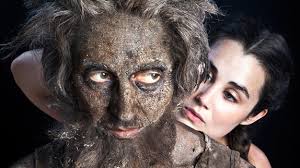
The opera does as good a job one could expect with this dichotomy. Writing a story you use nimble language to align the scene with the point of view of the observer, but with the meaty realities of the stage It’s a challenge to explore the nuances between a man portraying a dog and a man portraying a man pretending to be a dog. Veteran performance artist and dancer John Kelly straddles the line between man and canine, but with his wild hair and sinewy body, always remains edgily human, unlike the chameleonic Prince of the printed word, who could become all dog with a few well chosen phrases.
So why did I finish the short story completely satisfied, yet left the opera feeling utterly violated? I fear the creators failed to account for the fact that moving something from the mind’s eye of fiction to the flesh and blood physicality of the stage turns the haunting to the horrific, the unimaginable to the unwatchable.
The final paragraphs of the story describes Prince’s flight from the father’s rifle in gorgeous prose. The narrator insists on describing him as a dog even as in desperation he gets up to run as a man. Prince is at first “galloping on all fours across the yard, his tongue hanging out like a pink streamer” and then he is “on his hind legs, lurching away two-footedly, front legs pawing the air”. “Two-footedly”. Is there a more perfect word to express both the awkwardness of a motion as well as the awkwardness of the mental gymnastics it would take maintain the willful belief that this dog-man wasn’t actually born to walk on two feet? How do you show that complexity on stage in the brief seconds you have for that action? Not even the great John Kelly is going to come close to expressing what those two sentences communicate brilliantly.
And then the closing line of the story: “They run across the lawn, the pack of them, and fall upon him snarling.” The transformation is clear, succinct, beautiful. Upsetting, disturbing even, but not repulsive.
Consider instead seeing three men returning from offstage, faces and hands stained a shocking bright red with slick blood, meaty organs dangling from their mouths, shaking and convulsing while a shrieking orchestra blares out the same crunch that’s been crescendoing non stop for the past ten minutes. It’s garish, harrowing, and merciless. It’s beyond all proportion. Why?
And if that’s not enough, there’s more death, and a completely unrelated ritual involving yet more body fluids that has absolutely no basis in the source material. It’s like the creators, knowing that staging this would be uncomfortable, chose to double down on the horror. We’ve gone from post-apocalyptic coming of age parable to torture porn. It’s Grapes of Wrath by means of GWAR. Why? Why is this happening? What are you saying? What do you want from me? What did I do wrong? I TRUSTED YOU!
There are so many things one can take away from this short story: our ambivalent coexistence with animals as both food and companions, humanity’s capacity to devolve to animalistic behavior in the absence of structured society, our need to cling to the remnants of the familiar in stressful times, gender roles, the dissolution of the nuclear family… there’s a lot there. The opera manages to keep the remnants of many of these themes, or at least give them lip service, but then by ending with a sequence so abruptly discordant and severe, so aggressively hard to endure, it eclipses everything that’s happened before. The entire opera is about whatever the hell those last few minutes are about and nothing else. And… I’m afraid I just don’t know what that is. They’ve managed to take a short story that’s about a lot and reduce it to a grim spectacle that’s ultimately about nothing. An audience deserves better.
Heck. A dog deserves better.